Introduction
- localization - Formation - Composition
Cassini-Huygens - Earth and Titan ?
- Conclusion

(click on the picture ton enlarge)
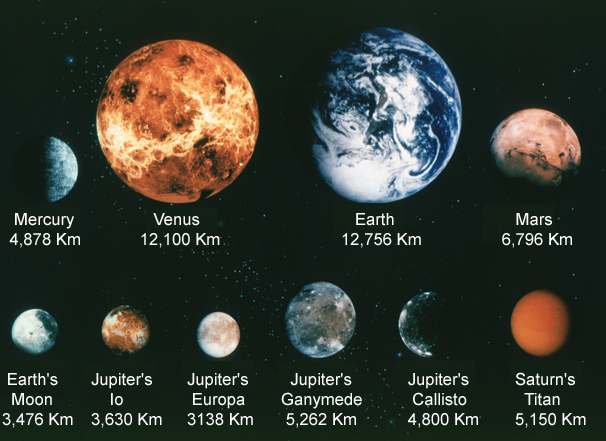 Titan
grew by accumulating smaller objects. Several collisions have made it that
big. After a collision, the heatwave provoked by it is distributed on the
satellite's surface until the inside gets colder than the surface once the
accretion is over. The surface temperature can become warm enough to make
the ice melt on a whole part of the satellite. The silicates that were present
in the ice then settle at the bottom of this liquid layer and form a new,
thick-based layer. This is how the satellite becomes differenciated for it
is made up of a rocky nucleus topped by a silicate and ice layer and then
surrounded by pure ice. Titan is more differenciated than other satellites
such as Ganymede, which is almost as big as Titan, because the latter's ice,
made of water and ammonia, melts at -100°C, while Ganymede's ice melts
at 100°C. After this stage, Titan underwent several distortions that aimed
at perfecting its orbit around Saturn, which was more eccentric than it now
is. This stage could have led to a form of volcanism on Titan. The satellite's
inner pressures are strong enough to allow several physical states to coexist.
The natureof their transition affectsthe global circulation of Titan's inner
convective movements, from a dynamic point of view. The heat draining loses
its efficiency and the satellites thus get warmer. Indeed, the highest temperatures
on titan's surface were hot enough to melt its ice made out of water and ammonia
; that is why the resulting draining of nitrogen took part in the forming
process and the maintaining of Titan's atmosphere.
Titan
grew by accumulating smaller objects. Several collisions have made it that
big. After a collision, the heatwave provoked by it is distributed on the
satellite's surface until the inside gets colder than the surface once the
accretion is over. The surface temperature can become warm enough to make
the ice melt on a whole part of the satellite. The silicates that were present
in the ice then settle at the bottom of this liquid layer and form a new,
thick-based layer. This is how the satellite becomes differenciated for it
is made up of a rocky nucleus topped by a silicate and ice layer and then
surrounded by pure ice. Titan is more differenciated than other satellites
such as Ganymede, which is almost as big as Titan, because the latter's ice,
made of water and ammonia, melts at -100°C, while Ganymede's ice melts
at 100°C. After this stage, Titan underwent several distortions that aimed
at perfecting its orbit around Saturn, which was more eccentric than it now
is. This stage could have led to a form of volcanism on Titan. The satellite's
inner pressures are strong enough to allow several physical states to coexist.
The natureof their transition affectsthe global circulation of Titan's inner
convective movements, from a dynamic point of view. The heat draining loses
its efficiency and the satellites thus get warmer. Indeed, the highest temperatures
on titan's surface were hot enough to melt its ice made out of water and ammonia
; that is why the resulting draining of nitrogen took part in the forming
process and the maintaining of Titan's atmosphere.
The Huygens-Cassini probe is going to be used in order to understand
how Saturn, its rings and its satellites were formed (see Cassini-Huygens).
Introduction
- localization - Formation - Composition
Cassini-Huygens - Earth and Titan ?
- Conclusion