Introduction
- localization - Formation - Composition
Cassini-Huygens - Earth and Titan ?
- Conclusion

1. Atmosphere
2. Air
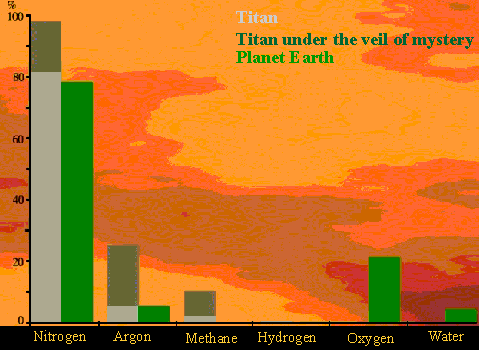
Saturn's biggest satellite's atmosphere is in many respects original : On the one hand, it is a bit similar to Earth because it is mainly made of nitrogen, and its surface pressure is around 1.5 bar. But on the other hand the surface temperature is only -170°C, due to its distance from the sun. A lot of the minor elements that make up Titan's atmosphere are methane and nitrogen compounds methane, ethane, ethylene but also HCN (hydrocyanic acid) and other nitriles. The existence of this complex organic chemistry that associates carbonaceous compounds and nitriles in a cold environment, is one of a kind in our solar system. The Cassini mission's main goal is to study Titan's environmental features by analyzing Titan's thick, cloudy layers, its composition and its surface's present state. How can methan, which is usually photodistintegrated inhigh atmosphere, be regenerated ? This phenomenon remains unexplained. Many theories have been put forward, such as methane rains accumulated in the lakes, ponds or in these sorts of mineral sponges called " clathrates "… But no actual evidence was found. Even though the pictures taken from telescopes seem to show methane clouds in Titan's troposphere, only a direct imagery of these clouds could allow the theory of these methane clouds - which is a bit similar to our water cycle - to be validated.
3. Soil
The surface pressure on Titan is peculiarly high for such a small world : 1.5 bar, compared with only 1 bar on Earth. The temperature is extremely low because the sun rays cannot reach the satellite's surface : About -180°C. Imagining an actual landing on Titan's soil would be difficult because of the thick clouds surrounding it. If ever this temperature was to be found on earth, everything would be frozen. On Titan, there is no oxygen, but there could be methane, ethane and nitrogen where the water, or rather the ice, is buried in the soil, for these gasses can be liquid. Because of high pressure and low temperature on Titan's surface, these 3 gasses, that can hardly be kept at a liquid stateon Earth, are kept close to their condensation state, therefore they con coexist in either of these three states : solid, liquid, gaseous.
Real observations of this satellite's
surface are uncommon, but do exist. On the one hand, nothing can be seen through
the ultraviolet rays, neither from Earth nor from space. On the other hand,
radar and spectral probes as well as images produced by infrared rays ans
photometric measures have always brought new elements in debates and speculations.
That is why some theoretical models can be found about physical conditions,
such as Titan's mass, density, chemical composition, temperature, pressure
etc. For instance, condensed ethane (which is quite similar to methane) can
be found at a liquid state on Titan's surface, hence the suggestion that the
satellite would be covered by oceans of ethane and methane. 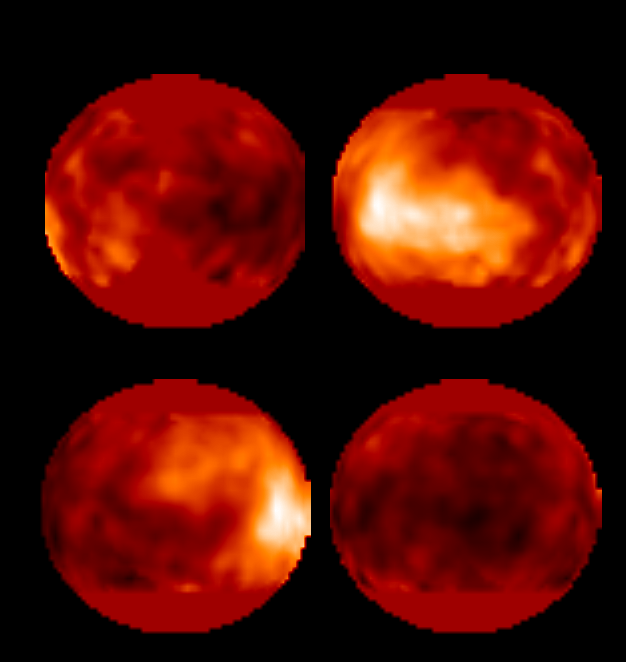
Nevertheless, the observations of the satellite, either from space (thanks to the Hubble telescope) or from Earth (thanks to new adaptable optical devices that allow astronomers to see through Titan's atmospheric turbulence), that have been made since 1994, managed to break through Titan's clouds. They were designed to find " windows " by sending specific frequencies similar to infrared rays. These windows are areas in which methane is less absorbed, and are a means to sound the lower part of the satellite's atmosphere - but also its surface. These pictures come as a confirmation to the 1994 spectral observations, which showed that most of Titan's soil was bright with some dark stripes. Its surface must therefore be heterogeneous, and cannot be totally covered with hydrocarbonaceous oceans. They also prove that there are rocks on Titan's soil, and also a localised lake made of hydrocarbons. There is also an uneven layer of methane clouds in the lower troposphere. The most recent image that was taken of Titan's surface is somewhat thrilling : Titan may be mainly covered with ice and organic sediments, but its morphology could be suitable for an icy relief with, perhaps, mountains or craters covered with methane snow, and whose edges, attacked by the waves, have created the numerous lakes of hydrocarbons…
The ambitious Cassini-Huygens mission was successfully launched from Cape Canaveral on October 15., 1997. In year 2004, we will finally reach that distant world. Thanks to this mission, the astronomers will find out the true nature of this small, hibernating moon and especially of its soil from which Staurn can hardly be seen.
While the Cassini orbiter, which was developed by the NASA, is achieving its scrupulous, four year long inspection of Titan through up-to-date digital software, the Huygens probe, which was built by the ESA (European Space Agency), will break through Titan's atmosphere and will try to land on its surface. These experiments should issue exciting results about what could become the great space mission for the upcoming years. In the meantime, there is no harm in dreaming of sci-fi landscapes, that would depict this cold, dark world that could soon become ours.
Introduction
- localization - Formation - Composition
Cassini-Huygens - Earth and Titan ?
- Conclusion