languages : french
- òõóóëéê
Introduction
- localization - Formation - Composition
Cassini-Huygens - Earth and Titan ?
- Conclusion

 Titan
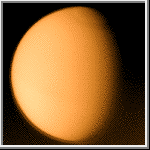
is the largest moon of Saturn and the second largest moon in the solar system,
rivaled only by Jupiter's moon Ganymede. Before the Voyager encounters, astronomers
suspected that Titan might have an atmosphere. Scientists also believed they
might find liquid seas or pools of methane or ethane; water would be frozen
due to Titan's low surface temperature. Expecting an unusual world, Voyager
1 was programmed to take numerous close up views of Titan as it flew past
in November of 1980. Unfortunately, all that was revealed was an impenetrable
layer of atmosphere and clouds. Only slight color and brightness variations
were observed.
Titan
is the largest moon of Saturn and the second largest moon in the solar system,
rivaled only by Jupiter's moon Ganymede. Before the Voyager encounters, astronomers
suspected that Titan might have an atmosphere. Scientists also believed they
might find liquid seas or pools of methane or ethane; water would be frozen
due to Titan's low surface temperature. Expecting an unusual world, Voyager
1 was programmed to take numerous close up views of Titan as it flew past
in November of 1980. Unfortunately, all that was revealed was an impenetrable
layer of atmosphere and clouds. Only slight color and brightness variations
were observed.
Although Titan is classified as a moon, it is larger than the planets Mercury and Pluto. It has a planet-like atmosphere which is more dense than those of Mercury, Earth, Mars and Pluto. The atmospheric pressure near the surface is about 1.6 bars, 60 percent greater than Earth's. Titan's air is predominantly made up of nitrogen with other hydrocarbon elements which give Titan its orange hue. These hydrocarbon rich elements are the building blocks for amino acids necessary for the formation of life. Scientists believe that Titan's environment may be similar to that of the Earth's before life began putting oxygen into the atmosphere.
In Greek mythology the Titans were a family of giants, the children
of Uranus and Gaia, who sought to rule the heavens but were overthrown and
supplanted by the family of Zeus.
Discovered by Huygens in 1655 (see picture).
Introduction
- localization - Formation - Composition
Cassini-Huygens - Earth and Titan ?
- Conclusion